Jill Konrath


Fresh Perspectives: The Latest From Jill


Get Fresh Sales Strategies

Your email:

Get More Free Sales Resources

Current Articles | RSS Feed RSS Feed

How to Ask for an Appointment in an Email Cold Call


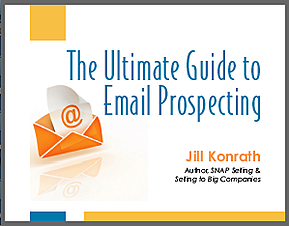
Email prospecting guideWhen I got the message below from Daniel McLellan, I had to share it with you. The way he "closes" his emails is much better than what I recommended in my new Ultimate Guide to Email Prospecting. <Click here to get your free copy!>

Why is it better? The person on the other end feels like they're talking to a human being, not a salesperson. It reduces their defensive responses and opens them to actually talking with you -- just like you're talking to them. 

But enough of my pontificating. You need to read what he wrote:

email cold call

I love your stuff. Your email strategy just paid for my new backyard deck! I used to send a hundred template emails and get no response. Now, I take that same time to send 10 strategic cold call emails with ample research and will get 5 responses.

There is one part of your strategy that I needed to substitute though - the action you're driving to at the end.

I explain to my sales team that asking people to call you back is a bit obnoxious--even if there is value and reason. When you do that your prospects are left thinking, "Wait, you want me to call you? so you can pitch me? You want me to stop doing my job and search for time in my calendar to give you so that you can sell me? Are you kidding?"

Using your strategy increases response rates for sure, but even great emails will sometimes fail. This is why I take a different approach.

I try to put as much of the onus on me as possible to connect. 
Here are some ways that I do that. 

Example 1: "I have time free on Friday, July 6th at 2:00pm. I'll reach out to you then to discuss. I hope you're able to take my call." 

With this closing statement, you're:

  • Showing that you are not asking anything from them.
  • Carrying the labor of the continued conversation.
  • Passively trying to connect, not aggressively.

Example 2: "I'll reach out to Mary to see if you have some time free to discuss next week." 

By suggesting that you'll reach out to their executive assistant, you're:

  • Showing that you've done your homework.
  • Following the correct protocol for the continued conversation.
  • Not asking anything from them and their busy schedule.

Example 3: "I have time free on Friday, July 6th at 2:00pm. Are you free at that time to talk?"

By closing this way, you're:

  • Still asking them to do something, although it's minimal. They just need to check one date/time in their cal.
  • Giving them enough time (at least a week out) to ensure that they'll have a free spot on their calendar. 
Sometimes I'll offer two times a week out for them to choose from and then say, "Which date/time works best?"

By taking this approach, I'm applying a successful passive/aggressive strategy. I'm able to send 3 to 5 emails and make 3 calls without annoying the prospect...which isn't easy.

Here are a few suggestion to increase your email cold calling success rate using this approach: 

  • If I don't reach them, I leave a voice mail and send an email stating, "I guess this didn't turn out to be a good time. Let's try again for Wednesday at 3pm."
  • On the morning of my proposed meeting I'll send an email stating, "As per my message, I'll be calling you today at...I hope that we're able to connect. Please let me know if that time doesn't work."
  • I'll continue this for 3x per prospect, then back away. After the 3rd attempt, I usually say, "I guess this time frame is way too busy for us to connect. I'll try again in the future. In the meantime, feel free to contact me..."
  • I then move on to someone else in the company after the 3x.
  • I try to splice the attempts with value. Before the scheduled call attempt, I may forward them an article stating, "This company looks like they are going through the same thing as you...check out their approach". Or on a VM, stating, "By the way, B2B magazine has a whole section this month of the financial services vertical and I know that's a big focus for you guys."
email cold call

I love the simple elegance of Daniel's approach. The moment I read/heard it from a customer's perspective, I knew it was much more effective. 

P.S. Get your free copy of Ultimate Guide to Email Prospecting. You need to find out what comes before the "closing" comments. 

Question: Would you respond better to this closing that your typical approach? What else works well for you? Share your comments now.


eBook: LinkedIn Sales Secrets Revealed


Jill KonrathJill Konrath is an internationally recognized sales strategist. As author of two bestselling books, SNAP Selling and Selling to Big Companies, she's a frequent speaker at sales meetings and conferences. For more fresh ideas, download her free Prospecting Toolkit.


Tags: 

Comments

Love the simplicity of this and how it doesn't force all of the onus on the prospect.  
One thing I heard a customer of ours doing was sending out an email and then saying "Are you free at x day on x time to talk some more? I'll send out an invite to your calendar." Since a lot of people live by their Google or Outlook calendars, sending out an invite is less work to coordinate times and mark it down themselves.  
We've found this to be pretty effective at Tout - thoughts on the approach?
Posted @ Wednesday, August 15, 2012 3:11 PM by Lauren Buchsbaum
This a fantastic article for so many reasons - first and foremost, it's concise, useful and to the point information that one can put into practice immediately (my feeling is that most salespeople, like me, have the attention span of a fly and we like short, useful instructions.) 
Second, the fact that you published a book dedicated to these tactics, received constructive feedback on how to improve your strategy and not only did you recognize that the writer was correct, you did so publicly! Not always the easiest thing. Very impressive on all counts.
Posted @ Thursday, August 16, 2012 12:57 AM by Daniel Francès
Normally I don't send e-mails to cold call, instead I send snail mail with a book along with my cover letter (once I sent Jill Konrath book). When sending to small companies I write something like "I will be calling you next Thursday, between 3:00PM and 5:00PM, to book a meeting with you, if that does not work for you let Maria know when will be a good time to reach you." 
 
With big companies besides the book I also send a little questionnaire with the following options: 
1) I'm available 28-8-2012 at 5:00PM 
2) I'm available 6-9-2012 at 12:00AM 
3) I'm available ______ at ____ 
4) I'm available ______ at ____ 
5) I will delegate this to ______ 
6) I want to talk to you. Ask my Personal Assistant to put you through. 
7) I'm not interested. 
 
In the cover letter I ask him to fill the questionnaire and hang it hover to Maria (or whatever name his PA has). 
 
This second approach does not work very well with small companies (with small companies the first one works better), but with big companies it works like a charm.
Posted @ Thursday, August 16, 2012 2:08 PM by Ricardo Patrocínio
Great suggestions, Jill. Rather than assuming they will want to call you back (the probably won't) you put the responsibility on you. All they have to commit to is being there. 
 
Cheers, 
Marc
Posted @ Friday, August 17, 2012 6:55 AM by Marc Zazeela
I do not agree with this method. I think it quite presumptous to assume your prospect wants to meet with you and I would not respond. What I hear clients say is do your homework, find out what issues I am dealing with and approach me about sharing how you have solved these problems elsewhere. Rule of thumb is 7 contacts before you give up, 50 calls and 50 emails.
Posted @ Monday, August 20, 2012 7:54 AM by Kathy Minchew
I absolutely love Dan's strategy. He sounds courteous, professional, and NOT annoying! Even the way he structured his email to you you can tell that he knows what he's doing. I hope the company he currently works for appreciates a man like that, for they are far and few between. 
Thanks for sharing, Dan!
Posted @ Monday, August 20, 2012 10:57 AM by Karen Koster
Why do you assume that a "prospect" WANTS to meet with you in the first place? You may set a lot of appointments by forcing yourself onto their calendar, but forced appointment does not make willing sales. When I get calls/emails telling me they will be calling me at x day at x time I intentionally will ignore them simply because you've already pissed me off setting your own appointment BEFORE even knowing if I have the slightest inch of interest
Posted @ Monday, August 20, 2012 8:54 PM by Bob Jamoley
Thanks for all your comments and feedback. Much appreciated! 


To Kathy, we actually agree more than you think. Doing your homework and finding out the issues that you are dealing with is exactly what's described in the guide that's offered by Jill in this article. This strategy here is just for the last line after you've done all that. I'd never ask for the call without doing so. 


To Bob, yes this is a bit presumptuous, but we're talking about sales tactics. In most cases, the main goal is to speak to the prospect on the phone. 


That said, there IS a lot of merit to finding out if there is interest before suggesting a call, so I agree with you on that point. I believe in Permission Marketing, (as made popular by Seth Godin). So, your action at the end of the email (after using the strategy in this guide) can then be: 


Would you like to learn more on how... 


or 


Is this something that interests you? 


Great points! 


Danny 
 
Posted @ Tuesday, August 21, 2012 11:45 AM by Danny McLellan
I think this is a great strategy and worth testing out. I'll try it over the next month or so and let you know the results. 
 
On another note - Jill if you're able to get to South Africa again, look at 12 to 14 April, we'd love to have you visit us at the Professional Speakers Association of Southern Africa's Convention.
Posted @ Friday, August 24, 2012 1:04 PM by Jacques de Villiers
Definately useful tips. Will statrt using right away. THANK YOU.
Posted @ Tuesday, August 28, 2012 11:12 AM by Jenni Chiarotto
article.
Posted @ Thursday, October 11, 2012 7:20 AM by Shannon
very good
Posted @ Friday, November 30, 2012 4:31 PM by sarah
So yes yes this is all very nice and professional but REALLY using emails for cold prospects. 1) Those emails often got to spam 2) Most people gets 100's of emails per day and are not all that interested in "cold" anything 3) There are MUCH better ways to prospect than cold emails. And yes you spend little time and money but is there any sort of real ROI? Just sayin':) I've been a sales consultant & trainer for 25 years (http://www.adrianmiller.com) and right now, I back off from using this approach with clients.
Posted @ Friday, December 07, 2012 11:23 AM by Adrian Miller
Jill, 
I LIKE THIS A LOT! 
"Example 1: "I have time free on Friday, July 6th at 2:00pm. I'll reach out to you then to discuss. I hope you're able to take my call." 
 
However, I like it NOT because of the technique or the particular strategy but, rather, because of THE SPIRIT intimated in it. 
 
The spirit of professionalism and mutual respect is important to help both sides of the sales table get the best out of the sales meeting|relationship. 
 
If mutual respect is absent, one of the two parties becomes either an abuser or a beggar... 
 
Thanks, and Keep STRONG, Jill! 
+Vincent Wright
Posted @ Saturday, February 02, 2013 12:48 PM by Vincent Wright
I would never do business with a company that sends these emails. They annoy me. No, I am not available, and I never will be. If I need your product or service, I will call one of your competitors wo doesn't spam me.
Posted @ Wednesday, April 10, 2013 7:29 PM by Scott
Great topic! Thank you for sharing an out-of-the-box idea for an ever-evolving world and ways of prospecting. After reading this article several weeks ago, I really liked the ideas presented. I've used this approach maybe five times since. I did get positive responses back from four of the prospects. I did do my research and presented ideas in the email without divulging too much information as I ultimately want to get in front of the prospect. Since then, I have read the comments, which I had not done previous. My take, on what seems to be a split of positive and negative reactions to this approach, is that everyone has a preferred method of communication. I find that it differs from one generation to another, but I can't say that I can lump GenX or Baby-boomers into one style or another. I ask what their preferred method of communication is during our first live conversation. It is difficult to get someone on the phone these days and I find that I can get more information across in a thoughtfully composed email which helps to build my credibility, which is the goal. I'm going to continue to use Dan's method for a couple months and track the results. I'm also going to bring this topic before a group of my peers from different industries (ages 24 - 60+) at our next meeting. It will be interesting to get their point of view from the standpoint of them being on the receiving end of an email composed as per Dan's suggestion(s). Judging from the comments on this post, it should be a good debate.
Posted @ Tuesday, April 30, 2013 8:18 PM by Virginia Cunningham
My most successful method is to call, engage the assistant or secty-find out what they (the company is using or doing)and see if I can talk to the exec I need, or, if I need to talk to someone else first. Assistants always want to be helpful and screen out sales people. They will give you more info than most execs. Bottom line, follow up with an email to the assistant and cc the exec. Shows you are serious and gives you a valid reason to call back or stop in. Empathy, rapport, knowledge and persistence usually wins out. The 5 rule works! 2% of sales close on the first call, 3% of sales on the 2nd, 5% on the 3rd call, 10% on the 4th and 80% on the 5th. By the fifth call you are old friends and you should be moving ahead for a decision by the end of the first meeting or contact.
Posted @ Friday, June 07, 2013 3:16 PM by Rob
That's a good one Rob...I never heard of that. I am now going track what number call I am at, in addition to what stage of the sales cycle. I'm interested in seeing how well it lines up with those projections. Sounds dead on.
Posted @ Monday, June 10, 2013 7:38 AM by Danny McLellan
Post Comment
Name
 *
Email
 *
Website (optional)
Comment
 *

Allowed tags: <a> link, <b> bold, <i> italics